
its written by monica

Your job may be complicated. Your skincare doesn’t have to be
Introduction
After years of dealing with acne myself, I learned a lesson I now repeat to clients: your work may be complicated, but your skincare does not have to be.
A person working 8–12 hours a day in construction, hospitality, sanitation, healthcare, painting, farming, kitchens or other physically demanding environments does not need a ten-step routine. They need a routine that matches their skin, fits their life and is simple enough to repeat.
The real problem isn’t always lack of time—it is an overly complicated plan
Busy people are often told that clearer skin requires a long list of products. I disagree. The goal should be to identify what the skin actually needs and remove the unnecessary steps.
I think about skincare in two categories: what your skin needs and what you simply want to add. The want is negotiable; the need is not. A person who is exhausted after a 12-hour shift is far more likely to follow a four-step routine than a ten-step routine.
This is not an argument for doing nothing. Acne is a medical condition, and effective treatment depends on the type and severity of acne. It is an argument for doing the essentials consistently and adding complexity only when there is a reason to do so.
Dermatology guidance supports this philosophy: gentle cleansing, acne-appropriate treatment, non-comedogenic moisturization and sun protection are far more useful than repeatedly irritating the skin with aggressive products.

My acne journey taught me: more isn‘t always better
I prefer to call my experience an acne journey rather than simply a struggle, because I learned a great deal along the way. I made many of the mistakes I now warn people about.
I repeatedly changed skincare products. I used recommendations from almost anybody who mentioned a product. I over-washed my face, used harsh cleansers, became impatient and kept searching for something that would work immediately.
At one point my skin became extremely irritated and sensitive. It felt bruised and uncomfortable, and I experienced burning/prickling sensations and rash-like irritation. Looking back, I recognize that I had severely disrupted my skin’s barrier, although I would not diagnose a past condition retrospectively.
Eventually, out of frustration, I stopped almost everything I was using and kept things extremely simple. I called this experience ‘skin fasting’ at the time, although that is not a standardized medical treatment. What mattered was that I stopped repeatedly exposing already-irritated skin to multiple products. Within about two weeks I noticed a dramatic change in how my skin felt and looked.
The lesson was bigger than any one product: skincare is science. Skin reacts to ingredients, friction, environment and behavior. Sometimes the first step toward improvement is not adding another product—it is removing unnecessary irritation.
The four essentials: a routine you can finish before your day gets busy
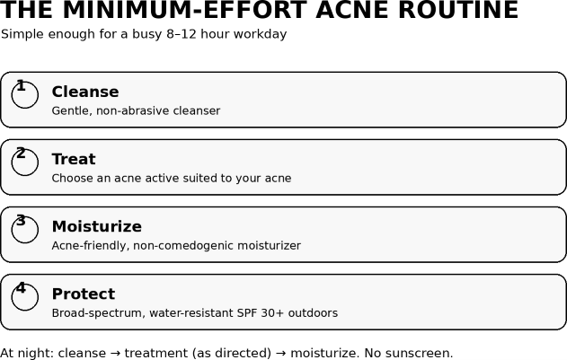
For most busy people, I would build the routine around four jobs: cleanse, treat, moisturize and protect. The exact product depends on the person’s skin and acne.
1. Cleanse
Use a gentle, non-abrasive, non-alkaline cleanser. The aim is to remove sweat, oil, sunscreen and daily buildup without scrubbing the skin raw. Dermatology guidance commonly recommends gentle cleansing up to twice daily and after sweating.
2. Treat
Choose an acne treatment that fits the acne you actually have. Common evidence-based topical options include salicylic acid, benzoyl peroxide and topical retinoids such as adapalene. The correct choice depends on the acne pattern, severity, tolerability and, for some treatments, pregnancy status.
3. Moisturize
Oily or acne-prone skin can still need moisturizer. Look for lightweight, non-comedogenic products. Moisturizing can help reduce dryness and irritation associated with acne treatments and improve treatment tolerability.
4. Protect
If you are outdoors, use broad-spectrum, water-resistant sunscreen with SPF 30 or higher and choose a non-comedogenic formula when possible. Sun protection is especially important when acne leaves dark marks or when treatments increase sun sensitivity.
At night, the routine is even simpler: cleanse, use the prescribed/selected acne treatment as directed, and moisturize. Sunscreen does not belong in the nighttime routine.

What I would leave out when time is limited
Acne patches, micellar water, sheet masks, multiple toners, repeated exfoliation and a cabinet full of serums can be optional—not automatically bad, but not automatically necessary.
If a product has no clear job in your plan, ask why it is there. If you cannot explain what it is doing for your skin, it may not deserve a place in a minimal routine.
The biggest mistake is trying to make up for a missed routine by doing more. Skincare is not a punishment. If you miss a step after an exhausting shift, do not scrub harder or layer five products the next morning. Simply return to the routine.
The 2-minute workday strategy for people who sweat, work outdoors or wear protective gear
You may not have access to a sink or bathroom during a shift. That does not mean you have failed.
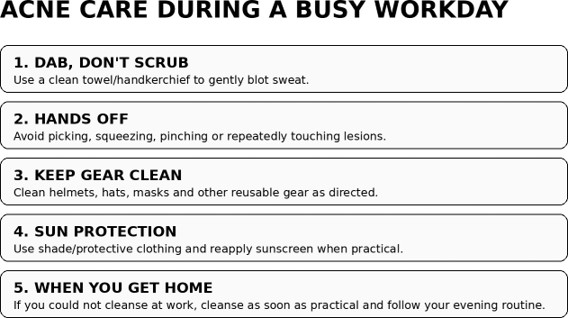
During work, the goal is damage control, not a second full skincare routine. If you are sweaty, gently dab rather than aggressively scrub. Use a clean towel or handkerchief and avoid repeatedly touching your face. Never use a dirty cloth to redistribute sweat and grime across your skin.
If you wear helmets, hats, masks or other reusable protective equipment, keep the parts that contact your skin clean according to the manufacturer’s instructions. Sweat, oil and friction can contribute to irritation and breakouts in susceptible people.
If you cannot wash your face during work, do not panic. When you get home, cleanse as soon as practical and complete your evening routine. The aim is consistency without guilt.
For outdoor workers, sunscreen is not a luxury. Use shade, protective clothing and sunscreen, and reapply according to the product directions and your exposure. If frequent reapplication is difficult, build sun-protective habits into the workday rather than abandoning protection altogether
Three things I see people do over and over
Over-washing. Many people believe that if acne is caused by oil, washing harder and more often must be better. It is not. Excessive washing, harsh soaps and scrubbing can irritate the skin and make acne care harder.
Skipping moisturizer because the skin is oily. This is another mistake I made. Acne treatments can dry and irritate skin, and the American Academy of Dermatology notes that moisturizer can help people tolerate treatments such as benzoyl peroxide, salicylic acid and topical retinoids.
Changing products every week or two. Acne treatment is not instant. The AAD advises giving an acne treatment time to work; for some commonly used treatments, early improvement can take several weeks, with fuller improvement taking longer. NICE recommends a 12-week first-line treatment course for many acne treatment plans.
Picking and squeezing. This can prolong inflammation and increase the risk of scarring and post-inflammatory hyperpigmentation. Busy or stressed people are not immune to this habit, especially when they are checking the mirror repeatedly.
These were not just mistakes I saw in other people. They were mistakes I made myself.
Two client stories: why the simplest routine still has to be the right routine
Two clients taught me an important lesson: ‘simple’ does not mean ‘the same for everybody.
One was a university student with severe acne and a diet dominated by sugary drinks and highly processed comfort foods. I educated her about the possible relationship between diet and acne and, more importantly, helped her move away from random product use toward a structured routine. Current clinical guidance does not support prescribing one specific diet as an acne cure, so I would not tell readers to blame their acne on food. Instead, I would encourage a balanced diet and attention to personal patterns while treating acne appropriately.
The second client had severe acne alongside substantial friction, sweating and occlusion from clothing/face covering, plus repeated use of random skincare products. Her skin appeared highly irritated. Rather than adding more products, we simplified the routine, addressed the acne appropriately and reduced unnecessary irritation and friction.
When they returned after about four weeks, I saw meaningful improvement in both: fewer active breakouts and
calmer-looking skin. That was encouraging, but I would not use four weeks as a promise for everyone. Acne treatment timelines vary, and clinical guidance commonly uses several weeks to months—not days—as the meaningful treatment window.

How do you know your routine is working?
The first sign is not necessarily a completely clear face.
I tell clients to watch for three early signals: the skin looks and feels calmer, breakouts begin to reduce, and burning, itching or irritation settles rather than escalating.
Later, dark marks can gradually become less noticeable, and the overall texture and number of active lesions can improve. Significant improvement is usually cumulative.
A useful rule is this: if a product causes persistent or significant burning, swelling, rash, worsening irritation or other concerning reactions, do not simply force yourself through it. Stop and seek appropriate advice, especially if the reaction is severe.
On the other hand, if your skin is tolerating the routine and you are seeing gradual improvement, do not throw it away after one or two weeks simply because you are impatient. Changing treatments too frequently can itself irritate skin and make it difficult to know what is helping.
When a ‘simple routine’ is no longer enough
A minimalist routine is not a substitute for medical care when acne is severe, persistent or scarring.
Seek professional assessment if you have deep, painful nodules or cysts, significant scarring, rapidly worsening acne, substantial dark marks, severe irritation, or acne that is not improving despite an appropriate period of consistent treatment.
This is particularly important because severe inflammatory acne can scar, and some treatments require professional supervision. NICE recommends treatment plans based on acne severity and advises escalation when appropriate.
My message to clients is simple: you have started the good work; sometimes the next step is letting a qualified professional finish it.

Your job may be complicated. Your skincare doesn’t have to be.
If you work long hours, sweat heavily, wear protective equipment or simply come home exhausted, stop telling yourself that good skincare requires a complicated ritual.
Start with what your skin actually needs. Keep the routine realistic. Use products with a clear purpose. Avoid unnecessary irritation. Protect your skin from the sun when exposed. Then be consistent.
Your skin is constantly giving you information. Pay attention to how it reacts to products, friction, stress, sleep, environment and your routine. Do not treat every reaction by adding another product.
I learned this the hard way over many years. Today, I would rather give someone a simple routine they can follow consistently than an impressive-looking routine they abandon after a week.
So when you look at your routine after a long day, I want you to be able to smile and say: ‘I got this.’ You do not need everything. You need what your skin needs.
And consistency is king.
Quick-reference routine
| When | Do | Keep it simple |
| Morning | Cleanse ® acne treatment ® moisturize ® sunscreen | Use only what has a clear purpose |
| During work | Dab sweat; hands off; keep gear clean; protect from sun | No need for a full second routine |
| After work | Cleanse if you couldn’t earlier | Remove sweat, sunscreen and daily buildup |
| Night | Treatment as directed ® moisturize | No sunscreen at night |
Suggested internal-link opportunities
Internal-link opportunity: “Acne skincare for physically demanding jobs” — Use this anchor to link to your existing/ future article about acne care for construction workers, tradespeople and other physically demanding jobs.
Internal-link opportunity: “How to choose an acne cleanser” — Use this anchor to link to your cleanser guide.
Internal-link opportunity: “Why sunscreen matters for acne and dark marks” — Use this anchor to link to your sunscreen/acne pigmentation article.
Internal-link opportunity: “Acne myths and mistakes” — Use this anchor to link to your article covering common acne mistakes and misconceptions.