
its written by monica
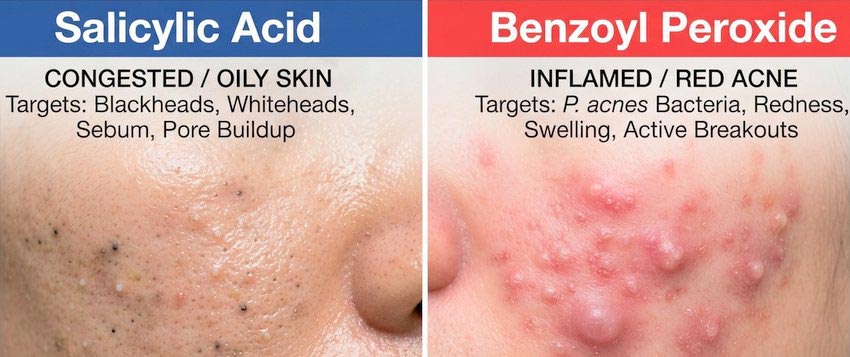
A practical, science-led guide to choosing between two established acne-fighting ingredients
If you are standing in front of a shelf wondering whether salicylic acid or benzoyl peroxide is the better choice for your acne, you are asking the right question—but there is no universal winner.
Both are well-established acne-fighting ingredients. The better choice depends on what your acne actually looks and feels like, your skin type, where the acne occurs, how irritated your skin is, and whether your skin barrier is already compromised.
My approach is simple: skincare is a science. You have to put the round peg in the round hole.
After dealing with acne myself for more than 15 years and working with people with different acne patterns, I have learned that one of the biggest problems is not a lack of products. It is using the wrong product for the problem. So, let’s make the decision much easier.
My First Question: What Type of Acne Do You Have?
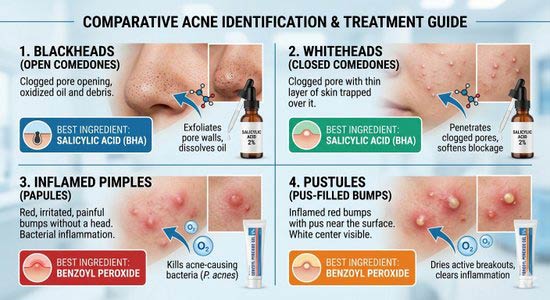
Before I choose between salicylic acid and benzoyl peroxide, I look at the acne itself.
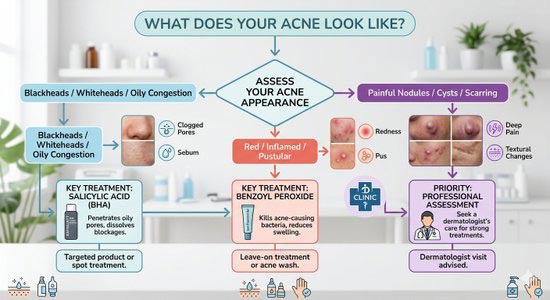
Is it mainly blackheads and whiteheads? Is the skin excessively oily and congested? Or are there red, swollen, inflamed, painful pimples or pustules? I also consider skin type, body location, irritation, current products and the condition of the skin barrier.
As a practical starting point:
• Blackheads, whiteheads, clogged pores, oily/congested skin often point toward salicylic acid
• Red, swollen, inflamed pimples and pustules often point toward benzoyl peroxide
• Painful nodules or cysts, significant scarring, or persistent/severe acne deserve professional assessment rather than relying on an over-the-counter ingredient alone
Salicylic Acid: The Pore-Clearing Specialist
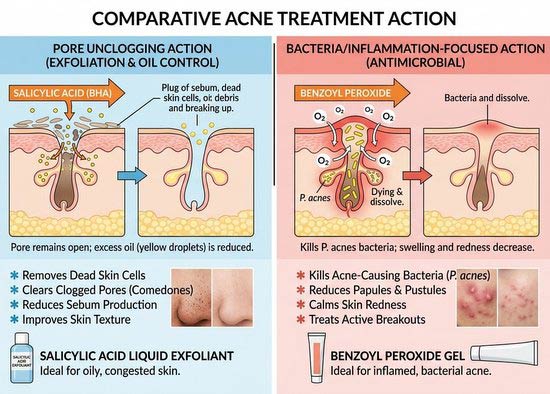
Salicylic acid is a beta-hydroxy acid (BHA). It helps exfoliate and unclog pores, which is why it is particularly useful when the main problem is congestion.
I especially think about salicylic acid when someone has:
• Blackheads
• Whiteheads
• Excessively oily or congested skin
• Mild acne
• Acne concentrated around oily areas such as the T-zone
In my experience, salicylic acid is often easier for people to tolerate than benzoyl peroxide. But “gentler” does not mean “use it as much as possible.”
Salicylic acid can still cause dryness, irritation or peeling, especially when the concentration, formulation or frequency is too aggressive for the individual.
It also is not the best answer for every acne pattern. If the dominant problem is significant inflammation, salicylic acid alone may not be enough.
Benzoyl Peroxide: The Inflammation-Focused Workhorse
Benzoyl peroxide is particularly useful when acne is red, inflamed and pustular. It works partly by reducing acne-causing bacteria and also has anti-inflammatory activity.
In my experience, benzoyl peroxide can be especially useful for angry-looking pimples that are swollen, red and painful. It is more aggressive than salicylic acid, so how you introduce it matters.
The American Academy of Dermatology recommends starting with 2.5% benzoyl peroxide for acne rather than automatically reaching for stronger formulations. Higher strength does not automatically mean faster or better results, and more irritation can make a routine harder to maintain.
One of the things I repeatedly tell people is: do not confuse strength with effectiveness.
Benzoyl peroxide can also bleach fabrics, towels, pillowcases and clothing. That is not a sign that the product is “burning” your skin; it is a chemical bleaching effect, so take care with textiles.
Salicylic Acid vs Benzoyl Peroxide: The Quick Decision
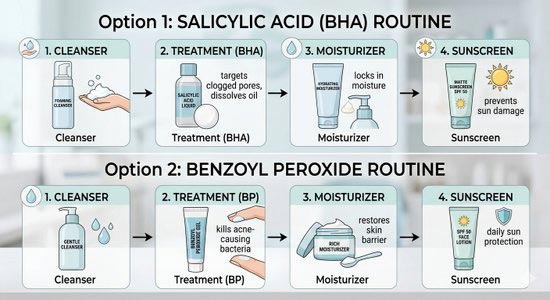
A simple starting framework is:
SALICYLIC ACID
Best suited to: blackheads, whiteheads, clogged pores, oily/congested skin and milder acne.
Main action: helps unclog pores and exfoliate.
Tolerance: often well tolerated, but can still irritate.
Starting principle: begin conservatively and follow the product directions.
BENZOYL PEROXIDE
Best suited to: red, inflamed pimples and pustules.
Main action: reduces acne-causing bacteria and inflammation.
Tolerance: more likely to cause dryness, redness or peeling.
Starting principle: 2.5% is a sensible starting strength for many people, consistent with AAD guidance.
This is a framework—not a diagnosis. Your full skin picture matters.
The Biggest Mistake: Thinking Stronger Means Better
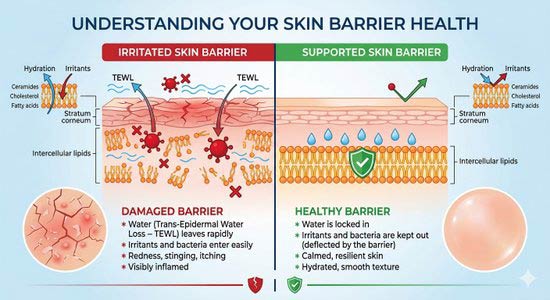
One of the biggest mistakes I see is the belief that a stronger product must work faster. Someone sees a 10% product and thinks: “If 2.5% works, 10% must work four times better.” That is not how acne treatment works.
With benzoyl peroxide, stronger formulations can produce more irritation without giving you a proportionally better outcome. With salicylic acid, the same basic lesson applies: more frequent or stronger use is not automatically better.
Your goal is not to win a battle against your skin. Your goal is to create a routine your skin can tolerate consistently.
A damaged or severely irritated barrier can make everything feel worse. Think of barrier care as first aid: before you keep adding treatments, make sure you are not repeatedly injuring the skin you are trying to improve.
An Important Benzoyl Peroxide Correction: Wash vs Leave-On
You may hear people say that benzoyl peroxide should always be left on briefly and washed off. That is too broad. Short-contact therapy can apply to benzoyl peroxide wash or cleanser formulations. For example, NHS guidance for benzoyl peroxide washes says to keep the wash on the skin for about 1–2 minutes before rinsing.
But leave-on benzoyl peroxide gels and creams are different. They should be used according to the directions for that specific product.
So the rule is: identify the formulation first, then follow its instructions. Do not automatically apply wash instructions to a leave-on product.
Can You Use Salicylic Acid and Benzoyl Peroxide Together?
Yes, they can be used as part of the same acne routine, but I would not automatically tell a new user to layer both strong treatments at the same time.
A more conservative approach is to separate them—for example, using salicylic acid at one time of day and benzoyl peroxide at another, or alternating days.
Another approach can be targeted use: salicylic acid for a congested/oily area and benzoyl peroxide for selected inflamed spots.
If you combine acne treatments, keep the rest of the routine simple: gentle cleansing, a suitable moisturizer and sun protection.
If you develop severe redness, burning, itching, marked peeling or significant irritation, stop the irritating actives and allow the skin to recover before reconsidering the routine.
How I Would Start Someone Who Is New to Acne Treatment
If you are new to acne treatment, do not begin by attacking your face with everything you can find.
Start by assessing:
- What the lesions look like: blackheads, whiteheads, red bumps, pustules, nodules or cysts.
- How they feel: tenderness, pain, burning or itching.
- How long you have had them.
- What you have already been using.
- Whether your skin is oily, dry, sensitive or irritated.
- Whether your skin barrier appears compromised.
Then choose the simplest appropriate starting point.
For a person with mainly blackheads/whiteheads and oily congestion, a low-strength salicylic-acid product may make sense.
For a person with red, inflamed pimples or pustules, benzoyl peroxide may be more appropriate.
Start slowly. A conservative frequency such as once or twice weekly can be reasonable for some leave-on products while tolerance is assessed, but the correct frequency depends on the formulation and its directions. Increase only if the skin is tolerating it.
Moisturize. Protect the skin from the sun. And do not stack several irritating actives simply because you are impatient for results.
What I Learned From Clients
One of the most useful lessons from working with different people is that acne does not tell the same story on every face.
One client was a medical student from eastern Nigeria. He had a demanding academic schedule, significant stress, irregular sleep and eating patterns, oily skin, poor skincare habits and extensive post-acne marks. His acne included severe inflammatory lesions, including nodules and cysts. In a situation like this, I would not treat the visible pimples in isolation; the history matters, and painful nodular/cystic acne warrants professional assessment because of the risk of scarring.
Another client, a student in her early twenties, had a different pattern: combination skin, whiteheads, blackheads, excessive oiliness and only one or two red bumps. She had little understanding of skincare and did not know the importance of sunscreen. Her needs were different, so salicylic acid made more sense as part of a simple routine alongside moisturizer, sun protection and education.
I have also worked with people who began with benzoyl peroxide and later settled into salicylic acid once the dominant inflammatory problem had improved.
That is why I do not believe in treating the ingredient instead of treating the person.
The Lesson From My Own Acne Journey
I spent more than 15 years dealing with acne. One of the biggest problems was not that there were no products available. It was that I did not understand the science behind what I was doing.
I changed products too quickly. I over-washed. I used harsh products. I picked at my skin. I was anxious about the acne and often reacted instead of following a structured plan.
Looking back, I was groping in the dark.
That experience shaped my philosophy today: follow the science behind the treatment, the product and the reaction of your skin.
If you have had acne for five, six, ten, twenty or even twenty-five years, it may be time to stop simply adding another product and start taking a proper skin history.
What have you used? How did your skin respond? What type of acne do you actually have? What is happening to your skin barrier? What are you doing consistently—and what are you changing every few weeks?
Sometimes the missing piece is knowledge.
When You Should Hand Over the Baton to a Dermatologist
There is a point where self-treatment should give way to professional care.
Seek medical/dermatology assessment if you have painful nodules or cysts, significant scarring, severe or widespread acne, persistent acne that is not improving, or acne that is having a major impact on your wellbeing.
This is especially important because deeper inflammatory acne can scar.
My philosophy is not “never see a dermatologist.” It is the opposite: know when your own skincare knowledge has reached its limit. If you have been struggling for years and repeating the same cycle, it may be time to hand over the baton so you can get closer to the finish line: healthier, more comfortable skin.
My Final Rule: Follow the Science
If you remember only one thing from this article, remember this:
Swollen, red, inflamed, painful pimples or pustules? Benzoyl peroxide may be the better starting ingredient. Blackheads, whiteheads, clogged pores and oily skin with milder acne? Salicylic acid may be the better fit.
New to acne treatment? Start low and slow. Give your skin time to show you how it reacts. And if your skin becomes severely dry, itchy, painful, burning or irritated, stop and reassess. Acne care is not about being aggressive. It is about being appropriate, consistent and patient.
Your skin speaks through how it responds to cleansing, treatments and routines. Learn to listen.
Follow the science.
Quick Takeaway
• Inflammatory, red or pustular acne: benzoyl peroxide is often the more useful starting ingredient.
• Blackheads, whiteheads and clogged/oily skin: salicylic acid is often the better fit.
• Start with a low strength and conservative frequency.
• Do not assume stronger means faster.
• Do not automatically layer salicylic acid and benzoyl peroxide together.
• Moisturize and use sun protection.
• Benzoyl peroxide can bleach fabrics.
• Benzoyl peroxide washes and leave-on products have different directions.
• Severe, painful, nodular/cystic, scarring or persistent acne deserves professional assessment.
• Most importantly: follow the science, not the hype.