
its written by monica

An honest, experience-led review of CeraVe acne products
Yes, CeraVe can work for acne—but I would never tell someone to buy CeraVe simply because it is popular. My approach is: put a round peg in a round hole. I have used CeraVe myself and have recommended it to customers with different acne patterns. My own acne journey taught me that changing products constantly, over-washing and attacking the skin are not the same thing as treating acne intelligently.
CeraVe’s current acne range includes 2% salicylic-acid Acne Control products and benzoyl-peroxide cleansers at 4% and 10%. The brand also has a Resurfacing Retinol Serum positioned for post-acne marks and texture. What matters is not the brand name alone. Match the active ingredient to the acne pattern, consider skin type and tolerance, and avoid turning your routine into an experiment with several new actives at once.
My personal experience with CeraVe’s 4% benzoyl peroxide cleanser came when I had very inflamed, painful acne. I found it unusually gentle compared with many products I had used before, while noticing less oiliness, clearer-looking pores, calmer inflammation and improved texture.
My client experience has reinforced the same principle: choose the product according to the skin in front of you. I do not present my client outcomes as a scientific success rate; they are my observations from the people I have worked with.
Severe, painful, nodular or cystic acne, significant scarring, worsening acne or acne that does not improve with consistent appropriate care should not become an endless cleanser experiment. That is when professional medical assessment matters.
Bottom line: CeraVe can work, but the better question is: which CeraVe product, for which acne, on which skin, and at what stage of the acne journey?
Introduction: The Question Behind the Question
If you are standing in front of a shelf full of CeraVe products and wondering, “Does CeraVe actually work for acne?”, I understand the question. I have been the person desperately looking for the product that would finally make my skin behave.
I have never believed in recommending an acne product I have never used. I want to understand how a product feels, how my skin responds to it and what happens when it becomes part of a real routine. My own acne journey lasted more than 15 years, and at one point I experienced multiple acne patterns at the same time
Today, my approach is simple: put a round peg in a round hole. Do not choose a product simply because it says “acne” on the label. Look at the acne. Look at the skin. Look at the active ingredient. Look at the skin barrier. Then make the decision.
My CeraVe Experience
The CeraVe acne product I remember most clearly is the 4% Acne Foaming Cream Cleanser. I used it after a period of jumping from product to product while struggling with pustules, papules and extremely inflamed acne.
My face could be red, swollen and painful. Sometimes the inflammation was so uncomfortable that it contributed to headaches. Even touching my face could hurt.
What surprised me was the gentleness. After using many products that made acne care feel like punishment, CeraVe’s cleanser felt soft and non-drying. At first, I wondered whether something this gentle could really do anything.
But my skin began to tell me otherwise. I noticed less oiliness, clearer-looking pores, gradually settling inflammation, less irritation and smoother texture. I also noticed gradual improvement in the appearance of the dark marks left by previous breakouts.
That experience shaped part of my opinion of CeraVe today: effective acne care does not have to feel brutal to be useful.
What CeraVe Gets Right: Acne Treatment Plus Barrier Support
CeraVe is interesting because several of its acne products pair acne actives with ingredients intended to support the skin. Its current 4% benzoyl peroxide cleanser includes ceramides, hyaluronic acid and niacinamide; its 10% wash also includes these barrier-supportive ingredients. Its 2% salicylic-acid Acne Control Cleanser combines salicylic acid with ceramides and niacinamide.
That combination matters because acne care is not only about the breakout. The surrounding skin matters too. If someone repeatedly strips, scrubs or irritates the skin, the routine can become harder to tolerate.
For me, that is the two-hit combo: treat the acne and protect the skin you are trying to improve.
CeraVe for Blackheads, Whiteheads and Clogged Pores
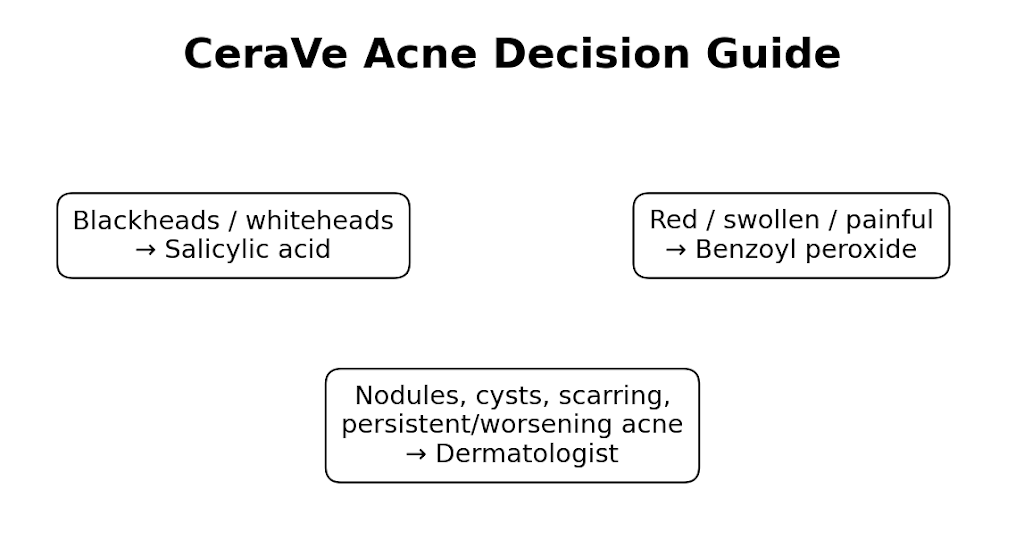
When the dominant problem is comedonal acne—blackheads, whiteheads, clogged pores and oily congestion—I usually think about salicylic acid first.
CeraVe’s current Acne Control Cleanser contains 2% salicylic acid and is positioned to clear acne, reduce blackheads and improve the appearance of pores. The Acne Control Gel also contains 2% salicylic acid.
In my practice, I may consider the cleanser for a wash-off option, while the gel may be considered when a leave-on approach fits the person’s skin and routine.
The key is not to look at the CeraVe logo and stop thinking. Ask: what exactly am I trying to treat? If the answer is congestion, blackheads and whiteheads, a salicylic-acid product may make more sense than automatically reaching for benzoyl peroxide.
CeraVe for Red, Swollen and Inflamed Acne
This is where benzoyl peroxide enters the conversation.
When I see red, swollen, painful pimples or pustules, benzoyl peroxide is an ingredient I take seriously. CeraVe currently offers an Acne Foaming Cream Cleanser with 4% benzoyl peroxide and an Acne Foaming Cream Wash with 10%
My personal experience with the 4% cleanser is one reason I appreciate the formulation. I was dealing with painful inflammatory acne, yet the cleanser felt gentle enough that I did not feel as though I was stripping my face.
But stronger does not automatically mean better. I do not want a first-time benzoyl peroxide user to look at 10% and assume that the highest number must work fastest. CeraVe itself advises starting with the 4% cleanser for first-time users and reducing frequency if bothersome dryness or peeling occurs.
What If You Have Both Types of Acne?
This is where real life gets interesting. Many people do not have one perfectly labelled acne category. They have blackheads, whiteheads, papules and pustules together. Their skin may be oily in some areas and irritated in others
That is why I do not treat the ingredient instead of treating the person.
In my experience, someone with a predominantly inflammatory presentation may start with an appropriate benzoyl peroxide cleanser, while someone whose inflammatory acne has settled may later need a maintenance strategy focused more on congestion and post-acne skin. The exact routine depends on the person’s skin, tolerance, other products and severity.
This is also why I tell people not to introduce four new acne products at the same time. If everything changes on Monday, how do you know what is helping you—and what is irritating you?
My Client Experience
A large proportion of the people who come to me are not dealing with one tiny spot. Many arrive after trying multiple products, often when their acne is already severe. I have worked with people presenting with combinations of inflammation, pustules, papules, cysts, discoloration and post-acne marks.
In my experience, many of the clients I have recommended CeraVe to have seen good results. I do not present that as a scientific success rate; it is my professional experience with the people I have worked with.
What matters most is the matching process. For inflammatory acne, I have often considered the 4% benzoyl peroxide cleanser. When the skin improves and the routine is tolerated, the next step may be different. For predominantly non-inflammatory acne, I have often considered a salicylic-acid CeraVe product.
The lesson I keep seeing is simple: the product has to fit the skin.
Follow the science of the product. Follow the science of the person’s skin. Then merge the two.
CeraVe for Post-Acne Marks and Rough Texture
CeraVe’s Resurfacing Retinol Serum is a different category from its primary acne cleansers. CeraVe’s Africa site positions it for post-acne marks, uneven tone and texture, while its instructions say to use it in the evening and build from once weekly as tolerated.
This matters because active-acne treatment and post-acne maintenance are not exactly the same job. If someone has severe inflammatory acne, a resurfacing serum is not a substitute for appropriate acne treatment. When acne is better controlled and the concern has shifted toward marks and texture, a product in this category may have a place if the person’s skin can tolerate it and it fits the rest of the routine.
The Biggest Mistakes People Make With CeraVe
The biggest mistake I see is not knowing what to use. People become desperate and anxious to see results, so anything labelled for acne can look attractive.
Other common mistakes include choosing the highest percentage because it looks stronger, starting several acne treatments at once, over-cleansing, scrubbing aggressively, expecting overnight results, skipping sunscreen, stopping treatment as soon as acne improves, and failing to check what other actives are already in the routine.
Do not make your skin suffer just to prove that you are serious about treating acne. A routine your skin can tolerate consistently is more useful than an aggressive routine you abandon because it hurts.
My Before-You-Buy CeraVe Checklist
1. Identify your acne: blackheads and whiteheads are different from red, swollen, painful pustules.
2. Identify your skin type: oily, dry, sensitive or combination.
3. Read the active ingredient: look at the ingredient doing the acne-treatment work, not just the brand name.
4. Start appropriately: do not choose a stronger percentage simply because it is available.
5. Start with one main acne treatment so you can understand your skin’s response.
6. Consider your goal: active-acne treatment or maintenance/post-acne care?
7. Check your existing routine so you do not blindly stack potentially irritating actives.
8. Keep cleansing gentle.
9. Moisturize and use broad-spectrum sunscreen when appropriate.
10. Know when to stop self-treating and seek professional assessment.
Treatment Is One Thing. Maintenance Is Another.
One of the most common mistakes I see is celebrating the end of active acne and then throwing away the routine that helped get the skin there.
Acne-prone skin can improve dramatically and still remain acne-prone. Occasional breakouts can still happen. That does not mean you have failed.
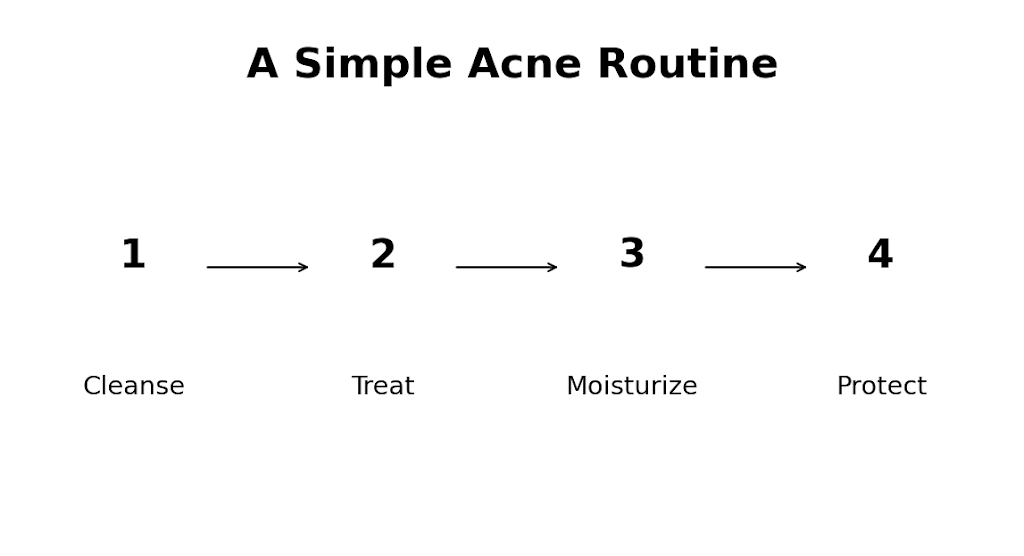
For me, maintenance means understanding what your skin needs once the main inflammatory problem has settled. Depending on the individual, that may include a gentle cleanser, a suitable acne active, moisturizer, sun protection and a product aimed at post-acne concerns.
The routine should evolve with the skin. It should not remain permanently aggressive just because the acne was once severe.
When CeraVe Is Not Enough
This is the point where I become very direct.
If you have painful nodules or cysts, significant scarring, widespread or persistent acne, worsening inflammation, severe irritation, or acne that is not improving despite a consistent and appropriate routine, do not keep buying another cleanser and hoping the next one will solve everything.
See a dermatologist or qualified medical professional.
CeraVe itself advises professional evaluation when an at-home regimen is not improving the skin or when acne is painful and interfering with daily activities.
CeraVe can potentially become part of a maintenance routine later, but the priority at that stage is getting the right diagnosis and treatment plan.
Three Internal Links
Best Benzoyl Peroxide Cleanser for Acne
Salicylic Acid vs Benzoyl Peroxide for Acne
Best Acne Cleanser for Physically Demanding Jobs
Final Verdict: Does CeraVe Actually Work for Acne?
Yes—CeraVe can work for acne. But I would never reduce the answer to “CeraVe works” or “CeraVe does not work.”
The better answer is: the right CeraVe product can be useful when it is matched to the right acne pattern and used as part of a sensible routine.
That is why I keep coming back to one phrase: put a round peg in a round hole.
If you have inflammatory acne, look for a product formulated to address inflammatory acne. If you have blackheads, whiteheads and clogged pores, look toward ingredients that make sense for congestion. If your skin is irritated, respect the barrier. If your acne is severe, persistent, cystic, nodular or scarring, know when to hand the baton to a dermatologist.
Do not buy skincare because it is famous. Do not buy the strongest percentage because the number looks impressive. Do not buy five treatments because you are anxious.
Be tactical.
solve.
Treat the acne. Protect the skin barrier. Follow the science. And give your skin the consistency and patience it needs.
That, to me, is how you make skincare investment worthwhile.
This article combines Monica’s personal experience and client observations with current manufacturer information. Individual acne treatment should be tailored to the person. Product formulations and availability can vary by country, so readers should check the current product label in their market. This article is educational and does not replace an individual medical evaluation.